Who Really Feeds Us?
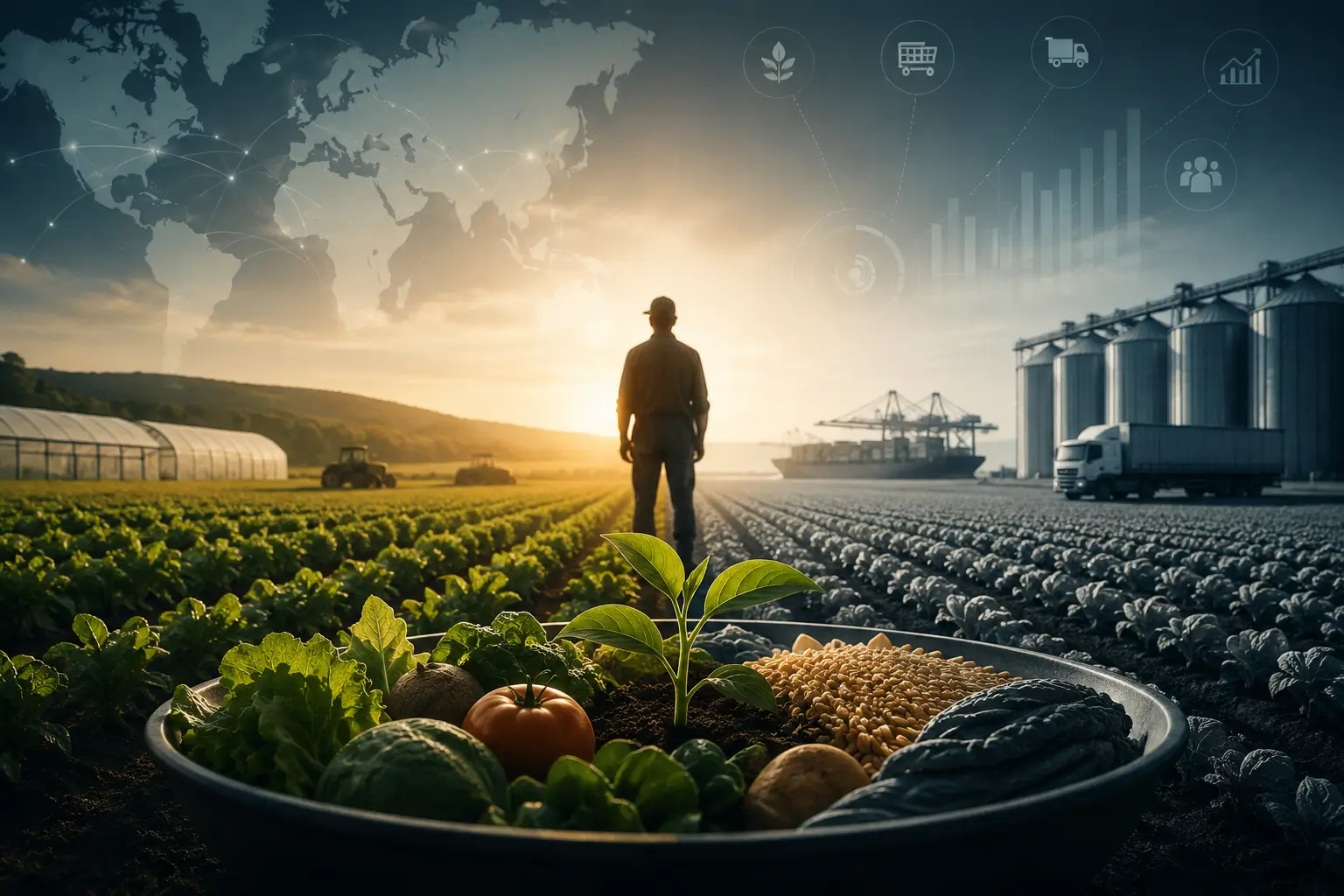
At a time when global headlines are dominated by wars, geopolitical conflicts, and billions being spent in the defense industry, some topics quietly slip beneath the radar. Not because they are unimportant, but because they are discussed far too little. One of those topics is food — more specifically, the quality, origin, and traceability of the food we consume every single day.
Food has long stopped being just a matter of choice. It has become a matter of health, economics, geopolitics, and long-term sustainability. Perhaps even more importantly, it has become a matter of security. And one of the key questions we rarely ask ourselves anymore is simple: do we actually know what we are eating?
About fifteen years ago, discussions around genetically modified food and crops began to intensify. Over time, rules and regulations were introduced, covering everything from seeds and cultivation to production, distribution, and food labeling. At the same time, we witnessed the rise of organic and bio food production. Yet an important question remains: how much of access to quality food today is truly a matter of choice, and how much depends on purchasing power?
The reality is simple. Not everyone can afford higher-quality products, local producers, or certified organic food. What we eat is often determined not only by our preferences, but by our financial circumstances.
In recent years, we have seen a strong rise in protein-enriched products, from yogurts and cereals to snack bars and functional foods. At the same time, discussions are once again taking place across Europe regarding the regulation of new genetic technologies in agriculture, as well as potential changes to rules governing GMO crops and food production. This naturally raises an important question: how much will consumers truly know about what they are eating in the future?
Personally, I am not against GMOs if they are properly regulated, controlled, and transparent. I am not against science or technological progress when they genuinely serve society. However, I strongly believe every individual should have the right to information — the right to know what they are buying, where it comes from, and how it was produced. Without transparency, markets stop being about informed choice.
One particularly important issue is the future of seeds. Generations before us were nourished by local, traditional seed varieties developed over decades and passed down from one generation to another. These seeds formed the foundation of food security in many communities. Today, conversations increasingly revolve around patents, biotechnology, and the growing influence of large corporations within global food supply chains.
Of course, every story has two sides. The global population continues to grow, and the demand for food is becoming an increasingly complex challenge. At the same time, we are facing a paradox: while demand for food is increasing, fewer and fewer people want to produce it.
Europe is not a major producer of GMO food compared to other parts of the world, but some countries still play a leading role in GMO crop production. According to publicly available European data, the largest producers of GMO crops in Europe include Spain, Portugal, Czech Republic, Romania, and Slovakia, with Spain by far the largest producer, particularly of GMO maize.
But perhaps an even more important question than GMO production itself is this: who will produce our food ten or twenty years from now? We live in a time when younger generations are increasingly moving away from agriculture as a career path. In the era of TikTok, Instagram, and digital professions, farming is often no longer viewed as an attractive profession. Yet without people willing to grow food, there is no such thing as food security.
As someone coming from Croatia, I became interested in several figures related to this issue. According to publicly available estimates and agricultural analyses, Croatia has approximately 100,000 hectares of abandoned or unused agricultural land. At the same time, the country imports roughly €5 to €6 billion worth of food and agricultural products every year.
It is worth pausing for a moment to reflect on that reality. We have land, tradition, and knowledge, yet we are becoming increasingly dependent on imported food. In a world that is growing more uncertain, food is no longer merely an economic issue — it is becoming a matter of strategic national security. Because a country that cannot produce enough food for itself inevitably becomes dependent on others.
Perhaps the real question is simpler than we think. Do we check where our food comes from? Do we know whether it is produced by smaller local farmers or large industrial systems? Do we support domestic producers when we have the opportunity? And perhaps most importantly — can we actually afford to choose better-quality food?
We do not all have to share the same opinion on GMOs. But we should all share the same interest: transparency. Transparency in production, labeling, and regulation.
Because in my view, the two issues that will ultimately shape the quality of life in every society are not politics or technology.
They are food and water.
And for now, at least partially, the decision to understand what we eat still remains in our hands.